
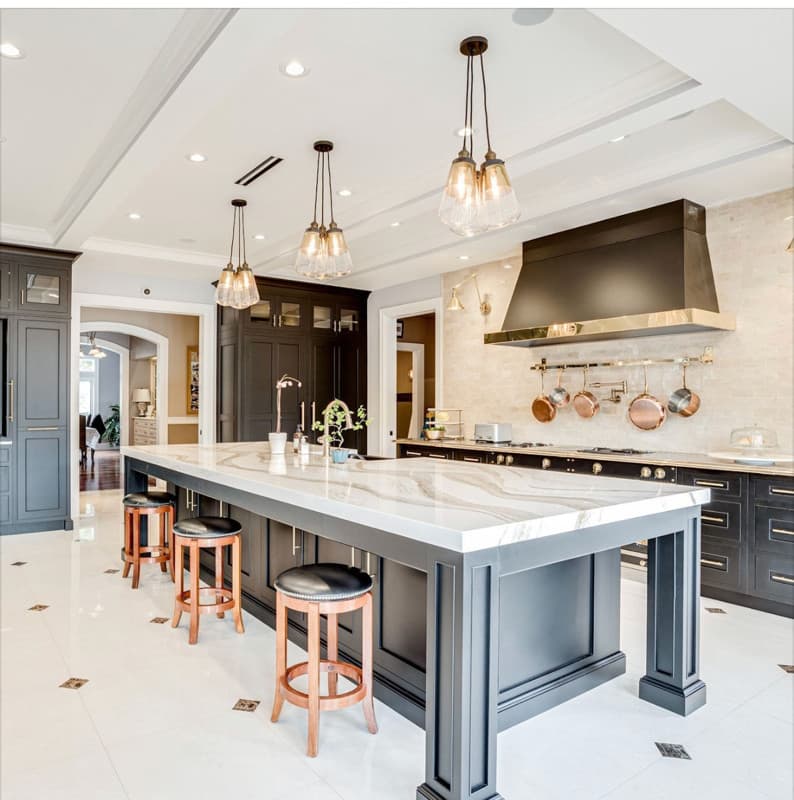
Quartz and granite have been the two big countertop choices in Richmond kitchens for years, and we compare them in our quartz vs. granite guide. In 2026 two other materials come up in almost every design meeting: quartzite and porcelain slab. Homeowners are also asking about news reports on engineered-stone countertops and silica. Here is how Kitchen and Bath Experts explains the options.
Updated November 2026.
Quartz (engineered stone)
Quartz countertops are made from ground quartz bound with resin and pigments.
- Strengths: non-porous, so it does not need sealing and resists stains; consistent color and pattern; wide range of looks, including marble-style veining.
- Weaknesses: the resin can scorch or discolor from a hot pan, and some colors can yellow in strong direct sunlight. Not recommended outdoors.
- Best for: busy family kitchens where low maintenance matters most.
Quartzite (natural stone)
Quartzite is a natural stone formed when sandstone is transformed by heat and pressure. It is often chosen by people who love the look of marble but want something tougher.
- Strengths: very hard and heat-resistant; dramatic natural veining; each slab is unique.
- Weaknesses: porous, so it needs sealing; cost is usually higher than mid-range quartz; and some stone sold as "quartzite" is actually a marble or dolomite that etches from lemon juice or vinegar. Ask your fabricator to test a sample with a knife scratch and an acid spot before you commit.
- Best for: an island or statement counter where you want real stone.
Porcelain slab
Large-format porcelain slabs are fired ceramic, typically much thinner than stone.
- Strengths: heat-resistant, UV-stable (good near sunny windows and outdoors), non-porous, and very stain-resistant. The same slab can run up the wall as a seamless backsplash.
- Weaknesses: the pattern on many slabs is printed on the surface, which limits edge profiles to simple squared or mitered edges; a hard knock on an edge can chip it; and it takes a fabricator experienced with porcelain to cut and install.
- Best for: modern kitchens, full-height backsplashes, and outdoor kitchens.
Side-by-side
| Quartz | Quartzite | Porcelain slab | |
|---|---|---|---|
| Sealing needed | No | Yes | No |
| Heat resistance | Fair (use trivets) | Excellent | Excellent |
| Stain resistance | Excellent | Good when sealed | Excellent |
| Scratch resistance | Very good | Excellent | Very good |
| Edge options | Many | Many | Limited |
| Look | Consistent, engineered | Unique natural veining | Consistent, can be dramatic |
What the engineered-stone silica news means for you
Most engineered quartz contains a very high percentage of crystalline silica. When slabs are cut, ground or polished without proper dust control, the dust can cause silicosis, a serious lung disease, in fabrication workers. In 2026 California's workplace safety standards board voted to begin rulemaking toward prohibiting the fabrication and installation of engineered stone with more than 1% crystalline silica. That is a California proceeding; it is not a rule in Virginia.
What this means for a Richmond homeowner:
- The risk is to the people cutting the stone, not to a family using a finished, installed countertop.
- Ask how your countertops are fabricated. A responsible shop uses wet cutting, dust extraction and respiratory protection to keep dust below the limits set by federal OSHA's silica standard.
- You have more options than before. Several manufacturers now offer low-silica engineered surfaces, and quartzite, granite, porcelain and solid surface are all alternatives.
We do not think you need to rip out an existing quartz countertop over this news. If the issue matters to you, tell us at the design stage and we will show you options.
How to choose
- Start with how you cook. Lots of hot pans and baking: quartzite or porcelain. Kids and spills: quartz or porcelain.
- Look at full slabs, not small samples. Natural stone in particular varies from slab to slab.
- Think about the edge and backsplash together. If you want a thick eased or ogee edge, porcelain is not the right fit. If you want the counter to run up the wall, porcelain or quartz works well. See our backsplash guide.
- Match the countertop to the room's light. A west-facing kitchen with strong afternoon sun is a better match for porcelain or quartzite than for a dark quartz.
Frequently asked questions
Is quartzite the same as quartz? No. Quartzite is a natural stone; quartz countertops are engineered from crushed quartz and resin.
Is quartz still safe to have in my kitchen? The health concern in the news is about dust created when workers cut slabs. An installed countertop does not create that dust in normal use.
Which countertop is the most durable? Quartzite and porcelain handle heat best; quartz handles stains with no maintenance at all. "Best" depends on how you use the kitchen.
Compare slabs with us
We will help you narrow down materials that fit your kitchen and budget, and include the countertop in one fixed price for the whole remodel. Schedule a free in-home consultation.